
Expanding Horizons (1971–1999)
Inside the Origins of Middle School's Washington D.C. Trip
One of the longstanding traditions at Lovett has been the Middle School trip to Washington, DC. Originally a 7th grade trip during the spring break period, the trip has evolved in many ways since its origins in the late 1960s.
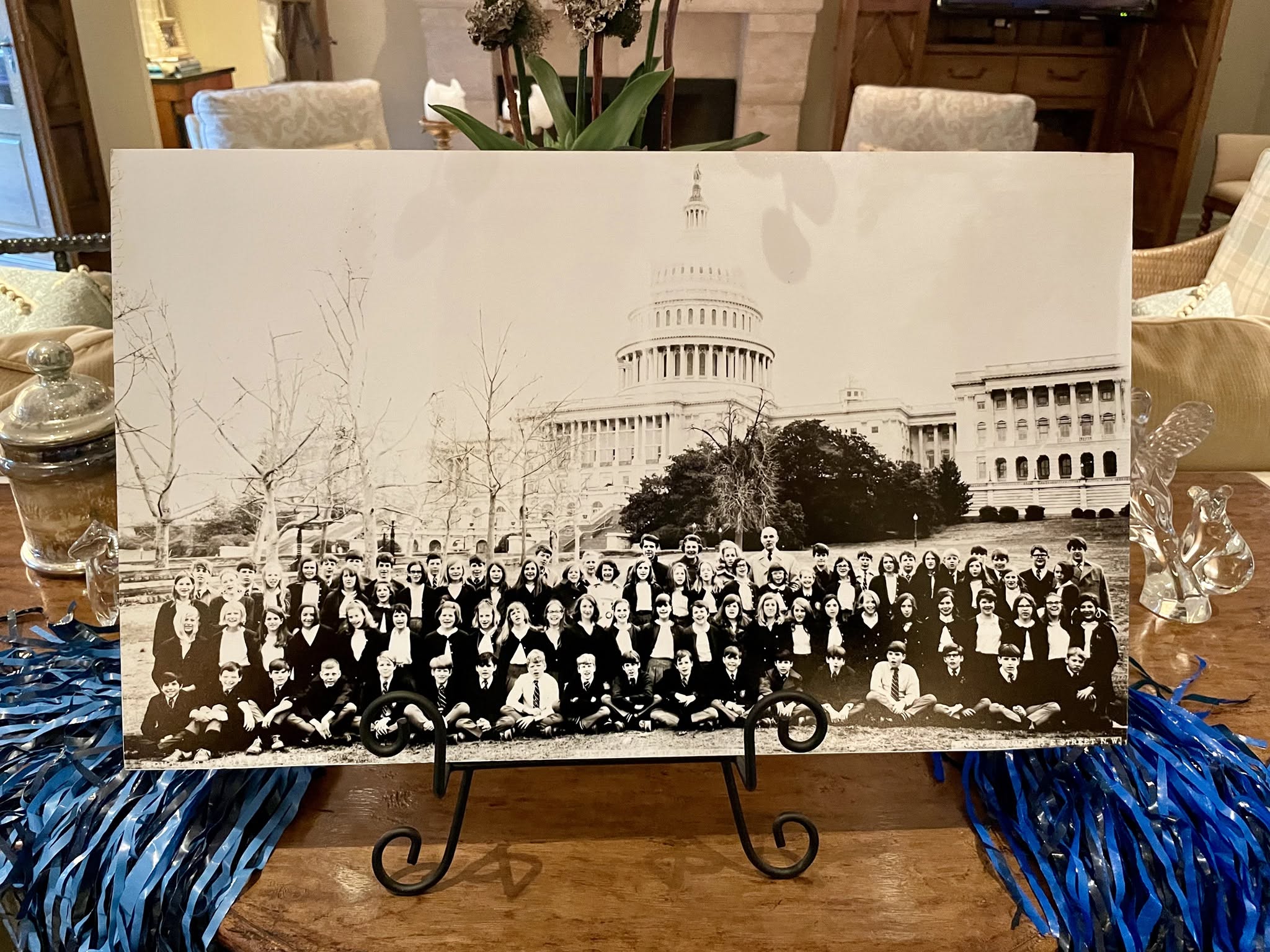
Our class was lucky to be one of the earliest to make this journey in the spring of 1970. More than 70 members of our class were a part of this trip. Our escorts were Middle School principal Bill Stephens and faculty members Jerry Beadle, Dan Pruitt, Betty Colson, and Anne Brandau.
Unlike today, air travel was much less available to get there. Our trip began at the majestic Terminal Railroad Station in downtown Atlanta. What followed was a 12-hour overnight ride on the Southern Railroad’s Southerner train to Charlottesville, VA. We departed for our first stop at Thomas Jefferson’s home at Monticello. We all knew about his presidency, but did not realize he was an inventor as well.
From Monticello, the class “went underground” with a trip to the Luray Caverns along the Skyline Parkway. We managed not to lose anyone despite all its nooks and crannies, stalactites, and stalagmites. At the end of a very long first day, we finally arrived at our main destination of Washington, D.C.
While many people see today's Washington, D.C., as a center of controversy, it was nothing like what we experienced in 1970. The streets of Washington were filled with Vietnam War protests, and the first hints of the Watergate scandal were becoming public. Our escorts had to keep a close eye on us during our visits to the Smithsonian, the many monuments around the city, and Capitol Hill.
At the Capitol, we were met by the Georgia Congressman Fletcher Thompson and Senator Herman Talmadge. They gave us a great overview of how bills become laws.
Probably the most solemn memories for us were our Sunday activities. We attended services at the Washington Cathedral. We were amazed by the history of the church and the Washington, DC area depicted in the stained-glass windows of the Cathedral. Following lunch, we journeyed across the river to Alexandria, VA, and Arlington Cemetery. We watched the Changing of the Guard at the Tomb of the Unknown Soldier and then visited the graves of both President John F. Kennedy and Robert F. Kennedy. At that time, they were assassinated just five and two years prior to our visit, so it was relatively fresh in our minds, not ancient history.
That evening's itinerary included a screening of the movie Patton. This would prove to be our most controversial visit during the Washington trip. Our parents were very upset when we returned to Atlanta. They were not upset by the violence depicted in the film, but by all those “dirty words” we learned. (Note: we already knew most of them!)
Our last two days of the trip were spent in Williamsburg, VA. It was terrific seeing the historic district, with all the costumed characters we met along the way. There were very few historical districts in the country at that time that compared to Colonial Williamsburg.
Overall, the trip was a wonderful way to bring to life the lessons we had been learning in our Civics and American History classes, opening our eyes to the much broader world beyond Atlanta in the 1970s. It was also a great bonding experience for our classmates, as we got to know each other for the first time outside of the classroom.
By: Lloyd Brown ’75