
Explore
Artifacts:
Explore the Lovett Museum
Every decade of Lovett’s history has left behind a physical trace. To celebrate our Centennial, we’ve curated a collection of iconic artifacts that preserve our traditions and offer a visual reflection of who we are.

Writings by Eva Lovett
Writings by Eva Lovett
Because few of her physical belongings remain, our understanding of Eva Lovett is primarily drawn from oral histories and her brother’s personal diary. However, a preserved collection of her handwritten speeches—delivered to parents and the Fulton County Pediatric Association—provides a vital window into her teaching philosophy. These writings reveal a perspective defined by professional pride and a deep-seated frustration with traditional educational methods.
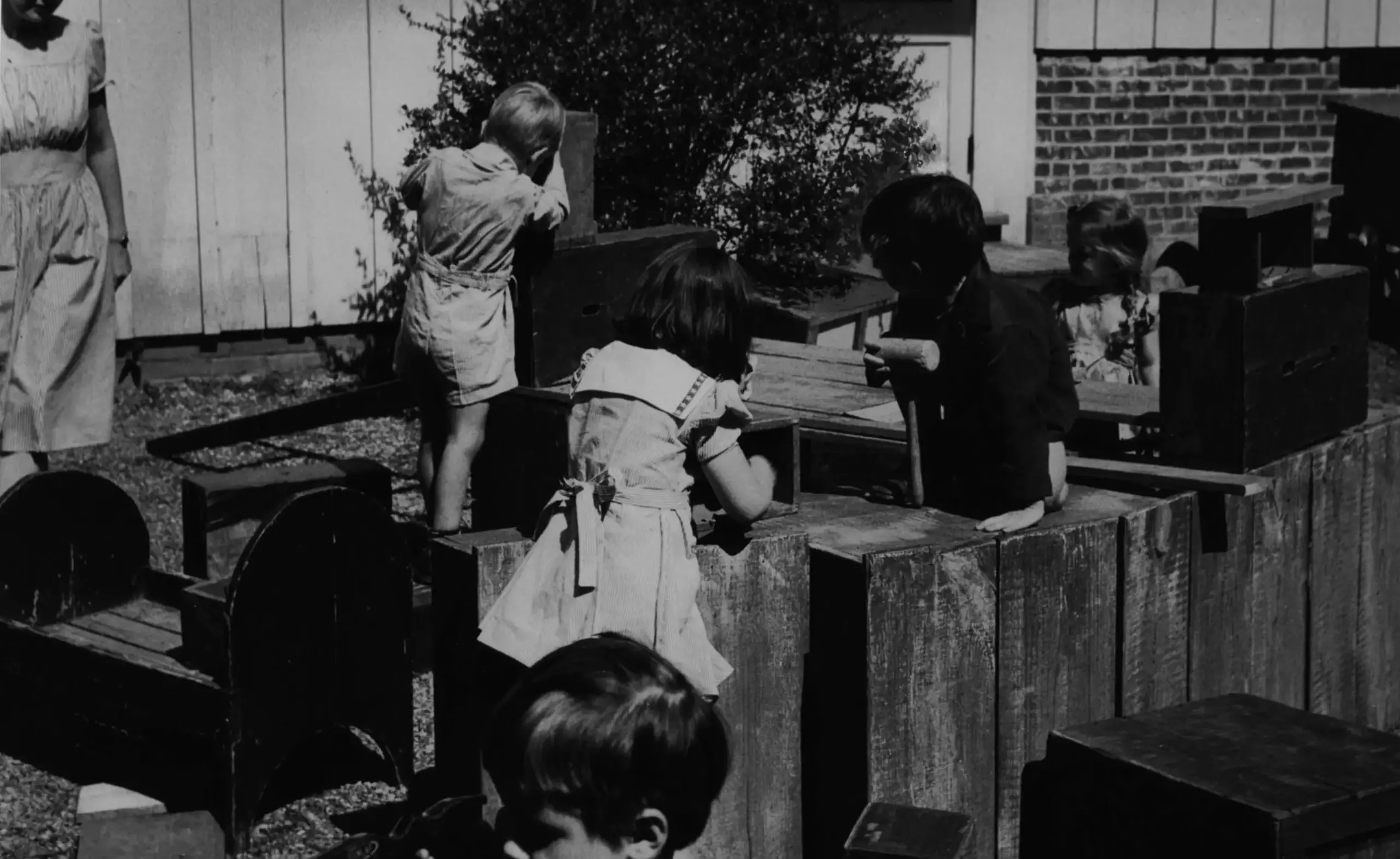
Lovett frequently argued that school should mirror real life rather than serve as a place where students merely "sit still and listen". She was openly critical of the "old order" of teaching, where children were confined to bolted-down seats and forced into silence. In contrast, her primary goal was to "set the body free," both literally and mentally.
Though she was occasionally hesitant about the term, Lovett frequently used the label "progressive" to describe her approach. To her, this meant treating every student as an individual. She maintained that if children were encouraged to follow their own interests and make their own choices, they would develop a natural desire to learn, as the process would no longer feel like "work". She was also a staunch advocate for the "whole child" approach, placing as much value on a student's social skills and peer relationships as she did on their academic performance.
While Mrs. Lovett championed student freedom, she did not view it as a lack of rules. Instead, she believed freedom provided the necessary space for students to think independently and even challenge the views of a teacher or a textbook. Her ultimate goal was for students to become “world-aware” and capable of independent decision-making so they could eventually emerge as good citizens. Ultimately, she viewed the classroom as a rehearsal for the real world—a place where children could experiment, fail, learn, and eventually discover their own passions.

Little Lovett Bucket Hat
Little Lovett:
Bucket Hat
This Little Lovett Bucket Hat belonged to Starr Moore, who attended Lovett’s nursery and kindergarten from 1949 to 1952. The archives also hold a news clipping donated by Karen Rohlin showing students wearing this same hat days before the 1952 Lovett Spring Fair.

In the photo, two sixth-grade students, Cornelia Dodderer and John Coulborn, watch over younger students like kindergartners Laurie Croft and Bobby Grier, as well as first graders Karen Rohlin and Gayle McLennan, as they fish for gifts with bamboo poles and fishhooks.
During the "Wesley" Era from 1936 to 1960, the school was located at 1415 West Wesley Road in Buckhead. While the original 1931 carnival took place in a Midtown backyard, by 1952, the event had evolved into a sprawling celebration across the wooded campus that Mrs. Lovett loved.
The bucket hat and branded t-shirts from this period serve as evidence of the school’s growing formal identity. While children in the 1920s and '30s often wore their everyday "play clothes" or Sunday best to school events, the introduction of school-branded gear in the 1950s marked a shift toward the "Spirit Wear" culture recognized today. The 1952 Fair would have been held under the massive oaks of the West Wesley campus, when the school was still quite small and intimate, with Mrs. Lovett herself serving as Principal before her retirement in 1954. Rosalind Rieser Needle ’52 remembered these carnivals featuring various attractions, including pony rides around the driveway, playing go-fish for prizes, bobbing for apples in a metal tub, puppet shows, Gypsies, and court jesters.

Little Lovett Desk
Little Lovett Student Desk
Locked away for years after Lovett closed its West Wesley Road campus in 1973, this student desk was nearly lost to history. Fortunately, when the property was purchased for redevelopment in the late 1970s, alumnus and trustee Rob Settle ’65 recognized its value and saved it from demolition.
Now part of the Lovett Archives, the desk features a classic wrought iron frame and a flip-top seat. Its desktop, which served the student seated behind it, even offers a personal glimpse into the past with a built-in inkwell and the initials "WH" carved into the wood by a former student.


1758 Book of Prayers
1758 Book of Prayers from the Church of England
This 1758 Book of Common Prayer, donated to Lovett by Caro duBignon Alston, is a remarkable piece of history that represents a specific window into the pre-Revolutionary era of the Church of England, printed during the reign of King George II. While the Book of Common Prayer had been largely stabilized by the 1662 revision, this 1758 edition is significant because it contains State Prayers for King George II and the Royal Family, just years before the American Revolution changed the colonial liturgical landscape. In the mid-18th century, these books were often imported from England to serve Anglican parishes in the American colonies, specifically in Georgia and South Carolina.

The donor's name, Caro duBignon Alston, links two prominent Southern families with deep roots in the Georgia coast and the Sea Islands. The duBignon family is famous for owning Jekyll Island, Georgia, after French aristocrat Christophe duBignon purchased it in the late 1700s, while the Alston family was a massive dynastic lineage in the Carolinas and Georgia associated with rice planting and leadership in the Episcopal Church. As an intersection of these two lineages, "Caro" (likely Caroline) duBignon Alston's donation of this 1758 prayer book suggests a family heirloom that survived the Civil War and the transition of the duBignon estate.
Ultimately, this artifact serves as a primary link to the Anglican roots of the Georgia colony. Such books were often more than religious texts, frequently serving as family registers with handwritten records of births, deaths, and marriages in their flyleaves.

Our Town Program
Our Town
While dramatic performances have been part of Lovett’s history since its founding, the tradition of formal theater took root in February 1962, when Upper School students first performed Our Town. It was a landmark event launched by the newly formed Dramatics Club and introduced a play that would be performed seven more times over the next 60 years, more than any other play.
That first production was a collaborative experiment; while most roles—from George Gibbs to the "Dead Man"—were shared by different actors across two nights, Headmaster Dr. Kellett anchored the show as the Stage Manager for both performances.


Circle Serve Tray
Circle Serve Lunch Tray
For 33 years, the Circle Serve was a staple of the Lovett dining experience. Installed in 1978, the system became an immediate success, featuring a large circular conveyor belt that spanned three-quarters of the serving area. Students would place their trays on small counters at various stations, selecting items directly from the moving belt before heading to their tables. The Circle Serve was decommissioned in 2011 due to increasing maintenance challenges.

Wood Carving
Wood Carving from Honduras
The Lovett School offers students a wide array of engagement opportunities, including summer reciprocal exchange programs with schools in Australia and England. Freshmen and sophomores who participate in these programs live in homestays for three to five weeks, fully immersing themselves in the local culture by attending school and participating in the daily lives and vacations of their host families. Lovett then offers the same hospitality to the students of its exchange partners.

This wood carving serves as a meaningful memento of Lovett’s former partnership with a school in Honduras, which concluded just before the COVID-19 pandemic.
It was gifted to Lovett by the final group of visiting Honduran students in February 2019. The inscription on the back identifies the gift givers as being from the El Buen Pastor Episcopal School in San Pedro Sula—a bilingual institution dedicated to fostering Christian values with innovative teaching and learning, with the aim of developing high-performing community leaders.

Seaboard Caboose
The Legend of the Lovett Seaboard Caboose
During the 1960s and 1970s, a unique landmark sat on the Lovett campus: a genuine SAL Class 5CC Caboose. Parked on the field behind the Lower School gym, roughly where Denny Field stands today, it was a magnet for student activity. While younger kids loved to climb on it, it also became a favorite hangout for Upper Schoolers looking for a bit of mischief, which might explain why the school eventually parted ways with it in 1992.
The "SAL" designation refers to the Seaboard Air Line Railway, a major rail network that served the Southeast from 1900 to 1967. In its prime, this caboose was far more than just the "end of the line." It served as a mobile office where conductors managed records and time sheets, and it provided essential living quarters—complete with beds and stoves—for the crew. Before the era of two-way radios, crew members relied on hand signals, flags, and lanterns to communicate with the train's front. It was often a bumpy and even dangerous ride; the "slack" from the train's movement caused erratic shifts, making the caboose one of the most challenging places to work on the rails.

Elizabeth Meriwether Painting
Landscape painting by Elizabeth Meriwether
This painting by Elizabeth Meriwether serves as a lovely piece of Atlanta’s local history, capturing a serene, idealized garden scene that likely reflects the aesthetics of Lovett’s campus or a prominent Atlanta estate from the early to mid-20th century. Given Meriwether's connection to Lovett during its foundational years following its 1926 establishment by Eva Edwards Lovett, this artwork stands as a significant artifact of the school’s early cultural and artistic identity.
The work is executed in a naive or folk-impressionist style, characterized by a structured, formal garden in which a prominent gazebo or summer house serves as the focal point. This central feature is surrounded by pathways that create a sense of "orderly nature," a signature element of Southern estate gardening during that era. The palette is vibrant and cheerful, characterized by "cherry blossom" pinks and reds in the trees, which contrast sharply with yellow and purple wildflowers. Small figures, possibly a woman and a child, can be seen near the gazebo, adding a narrative element of domestic tranquility and leisure, a theme commonly used to portray the "gentle" side of Southern life.
Elizabeth Meriwether’s presence at Lovett during the late 1920s and beyond places her at the heart of Lovett’s formative years. While the school originally started in homes in the Northside Drive area before moving to its current Paces Ferry location, this painting likely captures the spirit of the manicured gardens found in the Buckhead and Northside communities where the school was rooted. Teachers at Lovett during this time were often polymaths who contributed significantly to the curriculum, the arts, and students' moral character. Consequently, a painting like this would likely have been a personal project or perhaps a gift to the school or a fellow faculty member.

School Carnival
School Carnival
The School Carnival was a defining annual tradition for Little Lovett, exemplified by a 1931 newspaper clipping featuring students across various grades—from kindergartener Ashby Jones to fifth grader Ethel Hoffman—enjoying balloons and pony rides.
During this era, the carnival was more than just a day of fun; it was a fundamental expression of Mrs. Lovett’s "learning by doing" philosophy. Because the school was then located at 921 Myrtle Street, the festivities took place in the large backyard of a converted residence, creating a distinct residential, park-like atmosphere. These outdoor activities also served as a strategic showcase for the "Country Day School" model, which Mrs. Lovett championed to emphasize fresh air, physical activity, and a deep connection to nature.
The event was a significant community affair that drew together established families from the Midtown and growing Buckhead areas, supporting the school’s rapid expansion from just 20 students in 1926 to a population large enough to require a move to the West Wesley campus by 1936.
Beyond growth, the carnival was a practical demonstration of "social adjustment" and character building. As Eva Edwards Lovett noted around 1930, the school's focus was on each child's "adjustment to happy living with his fellows". This was visible in the way older students assisted younger ones, fostering the multi-age interaction that remains a hallmark of the school’s identity today.

Music At Lovett Album
Music At Lovett Album
Music At Lovett 1971–1972 is an album recorded by the Middle and Lower School choirs at Lovett and assisted by members of the first, second, and third grade instrumental ensembles.
Headmaster Allan Strand writes:
“The music program offered in the Lovett Lower and Middle Schools, under the direction of our Music Department, is a source of pride for all of us in the Lovett community. We are most pleased to be able to offer this recording of Christmas music sung by the choirs of the Lower and Middle Schools. I am sure that all of us will find real enjoyment from this recording as we celebrate the Christmas season.”
Songs on the album include:
Side One
- Softly The Stars Were Shining - Tovarsly
- Ye Shepherds Leave - French Carol
- Jesus is Born (The Holy Innocents’ Carol) - G. Bush
- Away In A Manger
- Jolly Old St. Nicholas
- Up On The House Top
- There Is No Rose - Benjamin Britten
- The Little Babe Benjamin Britten with Judith Beattie on Harp
Side Two
- Alleluia - K. Leighton
- Psalm 150 - Samuel Adler
- Allon Ouir (French Noel) - arr. J. C. Phillips
- A Merry Christmas - Carl Frangkiser with Lovett Wind Ensemble
- The Lovett Hymn - Beethoven, arr. Charles Brown ‘72 words by James E. Warren, Jr. with Lovett Wind Ensemble


Magic Piper
Magic Piper
Little Lovett made history on May 3, 1955, when its entire student body of 136 children performed The Magic Piper: An Operetta in 3 Acts by Hubrich and Christopher. Moving beyond the simple Pied Piper plays they had staged since the 1930s, the school presented this full, three-act operetta as the debut event for the Hall of Bishops auditorium at St. Philip's Cathedral.
The story followed the familiar path of a Piper cheated by greedy town officials, but added a hopeful twist: the children find their way home and teach the adults a lesson in citizenship. Led by sixth grader Tommy Hammer, the production was a true community effort, with students designing and painting the sets and program covers under the mentorship of teachers and parents.


Civil War Artifacts
Civil War Artifacts
In April 2001, as part of a master campus plan, Lovett hired an archaeologist to survey an area slated for a new faculty and guest parking lot. This site sits on the historic roadbed where Union forces crossed the Chattahoochee River during the Battle of Atlanta.
The excavation uncovered several significant military items, including a .58-caliber U.S. Lead Minié Ball, a soft-lead conical bullet that revolutionized warfare with its hollow-base design for faster reloading and improved accuracy. Crews also discovered a .69 caliber Lead Round Musket Ball, which was standard ammunition often used in "buck and ball" cartridges to increase lethality in smoothbore weapons. Other finds included an iron cap and a brass-and-steel pocket knife with a wooden handle.
Further artifacts were recovered by Charlie Brooks, a longtime Lovett U.S. History teacher and soccer coach. He found cannon fragments, a 12-pound solid shot cannonball, artillery lead fuses, and a horseshoe. 12-pound solid iron balls were commonly used in artillery such as the 12-pdr Napoleon and the 30-pdr Parrott guns during the Civil War. Unfortunately, the site also drew unauthorized activity, with additional items confiscated from trespassers during the summer of 2020.

Fashion Show Poster
"You’ll Lovett!" Rich’s Fashion Show Poster
This vibrant promotional poster, featuring a classic 1990s aesthetic and the punny tagline "You’ll Lovett!", serves as a colorful window into one of the school’s most storied community traditions: the Rich’s Spring Fashion Show. For decades, the Lovett-Rich’s partnership was a cornerstone of the Atlanta social and philanthropic calendar, blending high fashion with a deep commitment to the school’s educational mission. While the poster displays the bold, glamorous photography typical of the era, the event it represents marked a significant evolution.
Historically, the show was held in the Lovett School gymnasium, where attendees famously rode shuttle buses to sit on bleachers. By the time of the 37th annual show, the event broke tradition to meet growing demand by moving to the Cobb Galleria Center to accommodate over 1,000 guests, adding an evening edition for working professionals, and featuring the Lovett Jazz Orchestra alongside local news legend John Pruitt as emcee.
The show wasn't just about the "funky Jackie O" segments or the popular rayon prints of guest designer David Dart; it was a fundraising powerhouse that raised over $400,000 for Lovett’s educational programs in one eight-year span alone. The excitement was often palpable—legend has it that during a pre-show appearance at Rich’s, volunteers were so eager to try on the new collections they began draping the clothes over their business suits right on the sales floor. This prestige, along with the show's focus on student welfare, reached the highest levels of government. In 1988, organizers reached out to First Lady Nancy Reagan, inviting her to be the guest of honor and highlighting Lovett’s commitment to drug education. They offered her the podium to address students regarding her influence in the battle against drug abuse, noting that her presence would mean a great deal to the community. While Mrs. Reagan’s schedule ultimately didn't allow for the visit, the White House responded with a formal letter from her Director of Projects, noting the event's legacy as a significant cultural moment for the school.

Football

Do you have your own personal Lovett experience? |