
Our History
100 Years of Lovett
Founding Years:
1926-1953
1926
Our History
The Lovett School Is Founded
Eva Edwards Lovett opened The Lovett School for 20 students in Grades 1, 2, and 3 at 32 Peachtree Place.

1930
Our History
Move to 921 Myrtle Street
1928–1930 saw substantial growth of the school and a demand for a fifth grade that necessitated a move to a larger space. This move was made possible by renting the former home of Mr. Thomas K. Glenn at 921 Myrtle Street.

1931
Our History
Eleanor Roosevelt Visits Lovett
Eleanor Roosevelt, the wife of then New York Governor Franklin D. Roosevelt, visited Lovett after delivering an address before the Atlanta League of Women Voters.

1936
Our History
The Lovett School Incorporates
The first meeting of The Lovett School Board of Trustees convened on June 8, 1936. Charles A. Rawson was elected chairman of the board.

1936
Our History
Lovett Moves to West Wesley Road
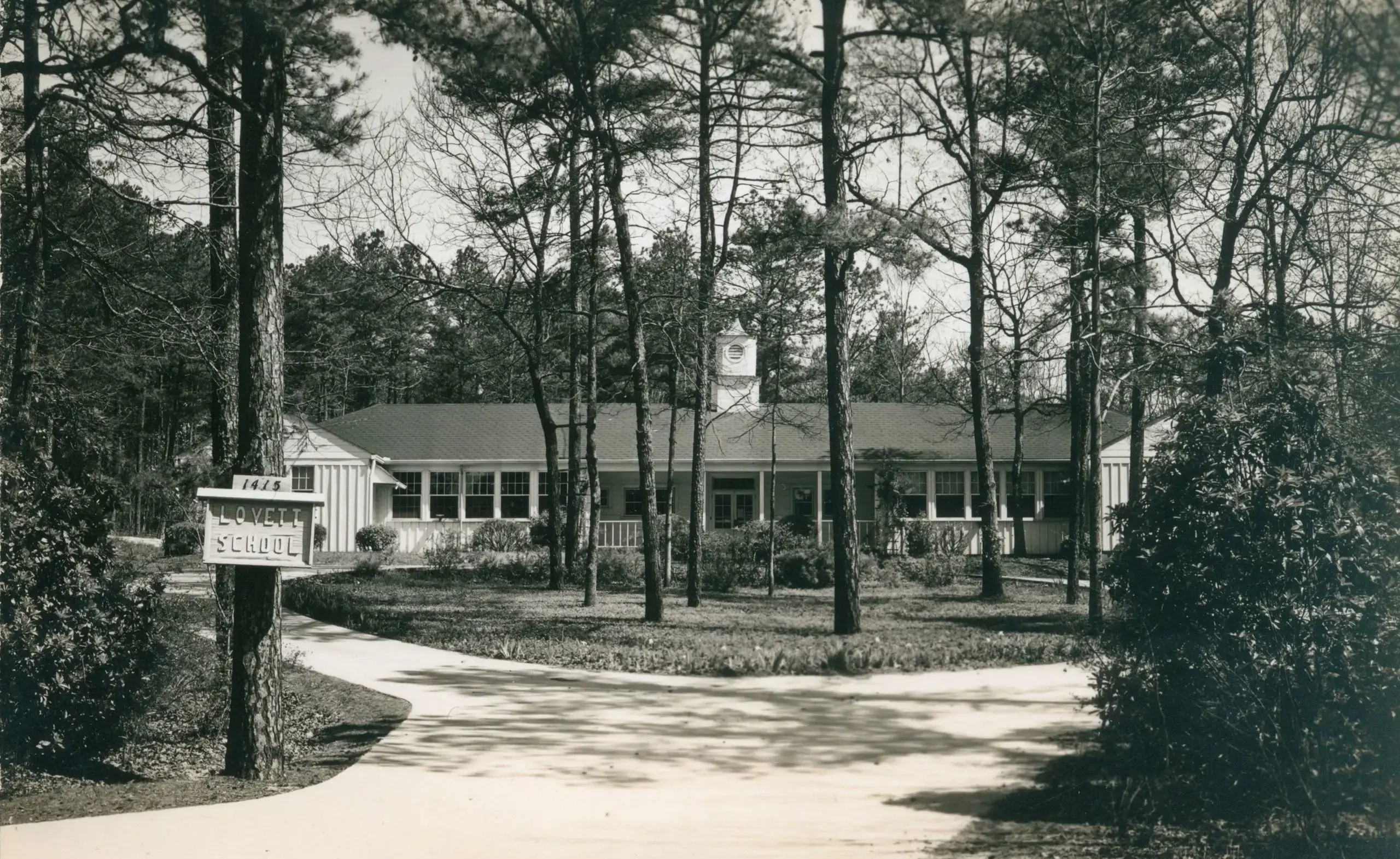
Supporters of Mrs. Lovett purchased 15 wooded acres at 1415 West Wesley Road in Buckhead. This location is what we today refer to as Little Lovett. The cost of attending Lovett ranged from $90 for Kindergarten to $175 for sixth and seventh grades.

Changing Times:
1954-1970
1954
Our History
Eva Lovett Retires and Ownership Transfers
Mrs. Lovett retired from her role as Principal of The Lovett School at age 81.
On June 15, 1954, Eva Lovett turned The Lovett School and all its property over to the ownership of The Cathedral of St. Philip. The school became known as The Lovett Episcopal School. In accordance with the agreed-upon provisions, each of the current trustees of The Lovett School resigned.

1955
Our History
First Fashion Show
The Mothers Club planned a fashion show with Rich’s Department Store to be held during the fall of 1955 in The Cathedral of St. Philip’s Hall of Bishops.

1958
Our History
Lovett Purchases Land on Paces Ferry Road
A motion was made and seconded by the Board of Trustees to acquire property to construct a larger school, providing improved facilities for even better instruction, as well as space for afternoon competitive sports, games, and other activities. Lovett ultimately purchased 83 acres of property located on Paces Ferry Road from John M. Slaton, Jr. for $3,000 per acre.

1959
Our History
Funding a New Space
A professional fundraising firm was retained in the spring of 1959 to raise money for buildings at the Paces Ferry Road Campus. A campaign to raise $1,250,000 was launched in May at a luncheon at the Capital City Club.
Image: Lovett Nursery Kindergarten Building, 1st, 9th and 10th Grades

1959

Left (top) image: Lovett 7th & 8th Grades, Trinity Presbyterian Church
Right image: Lovett 5th Grade, St. Anne's Episcopal Church

1959
Our History
Severing Ties
In November 1959, Lovett declared independence from the Episcopal church.

1959
Our History
First Football Game
The team practiced at Peachtree Hills public playground. They played five games and lost all of them. Before athletic facilities were constructed on the campus, official Lovett games were played at Campbell High School in Smyrna and at St. Pius.

1960
Our History
Move to Paces Ferry Road
Three major buildings were constructed: the Lower School, the first floor of the Middle School, and the Administrative Building. The 1960–61 school year opened with 1,024 students, representing all grades except 12th.

1960
Our History
School Uniforms Introduced
A school uniform was adopted in September 1960 in an effort to create a more unified culture.

1961
Our History
Additions to Campus
A new Upper School, later known as the Community Center, a Lower School Gym, and a playground were added to campus.

1962
Our History
Lovett Campus Expands
Lovett purchased 60 acres of land adjacent to the school property from Stuart Murray and the estate of Vasser Woolley for $250,000. This additional acreage extended the campus to the northwest and provided needed space for physical education and access to the expressway.

1962
Our History
Lovett Campus Expands
Lovett purchased 60 acres of land adjacent to the school property from Stuart Murray and the estate of Vasser Woolley for $250,000. This additional acreage extended the campus to the northwest and provided needed space for physical education and access to the expressway.

1963
Our History
Episcopal Diocese Severs Ties
When Martin Luther King III applied to Lovett, he was denied admission by the board of trustees because of the school’s segregation policies. This action violated the Episcopal Diocese’s stance on open churches and schools, and The Cathedral of St. Philip severed its ties with Lovett.

1964
Our History
Lovett Receives Top Accreditation
Both the elementary and upper schools were accredited by the Georgia Commission of Accreditation (and each year subsequently). The Upper School was accredited by the Southern Association of Colleges and Universities.
1967
Our History
Lovett Integrates
Segregation ended at Lovett in 1967, when the school adopted a nondiscriminatory policy evaluating students without regard to race or religion—one of the first independent schools in the South to do so. Third grader Alaric Tate became the first African-American student to enroll at Lovett.

1970
Our History
Football Team Wins State Championship
Coach Bill Conley’s football squad won the school’s first state football championship.

Expanding Horizons:
1971-1999
1976
Our History
Celebrating the 50th Anniversary
In honor of Lovett’s 50th anniversary, a capital campaign was launched to raise $4 million, of which $2 million was designated for a natatorium and gymnastics center, expansion of the dining room, relocation of the kitchen, and an addition to the Middle School to include classrooms and a multipurpose area. $50,000 was designated for the Lovett endowment in memory of Eva Lovett.

1976
Our History
Booster Club Becomes the LionBackers
The LionBacker Booster Club, organized by Lovett parent and alumnus John O. Knox ’69, held its first annual membership meeting.
1985
Our History
First Auction
The Lovett Mothers Club, later known as the Lovett Parent Association, held the first auction to increase the school’s endowment. It was chaired by Mrs. Frannie Hilsman, Lovett parent and wife of trustee and Little Lovett alumnus Skip Hilsman ’57.

1990
Our History
First Senior Upward Bound
Senior Upward Bound, later known as Junior Outdoor Experience, held its inaugural trip. The program was envisioned by former headmaster Jim Hendrix, who wanted to create an outdoors-focused program to help prepare seniors for the challenges of their final year.

1992
Our History
The Start of Siempre Verde
Lovett purchased 325 acres of cloudforest in Ecuador; students voted to name the property Siempre Verde.
1995
Our History
Alan Fuqua Center Is Dedicated
On October 15, 1995, the Alan Fuqua Center officially opened with a musical gala orchestrated by the Fine Arts faculty, students, and alumni. Mr. and Mrs. J. B. Fuqua gave a $2 million gift, the largest in Lovett’s history at the time. It was named in memory of their son, Alan B. Fuqua ’69.

1997
Our History
Lovett Goes Digital
During the 1997–98 school year, the school telephone system was upgraded to a fully digital communication system. Lovett’s first website was also developed. Thanks to the generosity of the LPA, six fax machines were added in various offices around campus.
21st Century:
2000-2026
2001
Our History
The Lovett School Celebrates 75th Anniversary
Following Opening Chapel, where a ceremonial anniversary banner was presented to the school community, all students, faculty, and staff formed “Lovett 75!” on the Kilpatrick Stadium field for an aerial photograph.

2006
Our History
Lovett International Alliance Formed
The Lovett International Alliance (now called Lovett Community Connections) is a parent-run organization dedicated to promoting cultural awareness and celebrating the diverse backgrounds of its families. It fosters global curiosity through events like WorldFest and other cultural celebrations.
2015
Our History
Investing in Athletics
Lovett renovated Kilpatrick Stadium and opened the Murray Athletic Center, which includes a wrestling room named in honor of legendary teacher and wrestling Coach Jim Glasser.

2018
Our History
Meredyth M. Cole Is Named Head of School
Meredyth M. Cole became the first woman to lead the school since Eva Lovett’s founding in 1926.

2024
Our History
Launching the Next 100 Years
Lovett launched its biggest campaign to date, the One Lovett Campaign, to support campus transformation, student support, and faculty support. The school received a $30 million gift—the single largest gift in the school’s history—to fund Rita Anne Rollins Hall, which is set to open in 2028.